When replacing resistors in the radio, one would think replacing with the exact part would be good.
Maybe but maybe not. If the original specification was for 5,000 ohms, ⅓ watt as is frequently the case in the earliest radios, there's no way you're going to find a modern replacement for that. They don't even sell ⅓ watt resistors any more.
This was found on some website that only gave you a few seconds to read before the page expired. I wasn't
able to capture the source information. I suspect the same text is available in a lot of places.
In 1952, the IEC (International Electrotechnical Commission) decided to define the resistance and tolerance
values into a norm, to ease the mass manufacturing of resistors. These are referred to as "preferred values" or
"E-series", and they are published in standard IEC 60063:1963. These standard values are also valid for other
components like capacitors, inductors and Zener diodes. The preferred values for resistors were established
in 1952, but the concept of the geometric series was previously introduced by army engineer Renard in the 1870s.
The standardization of resistor values serves several important purposes. When manufacturers produce resistors
with different resistance values, these end up approximately equally spaced on a logarithmic scale. This helps
the supplier to limit the number of different values that have to be produced or kept in stock. By using
standard values, resistors from different manufacturers are compatible for the same design, which is
favorable for the electrical engineer.
Aside from the preferred values, many other standards related to resistors exist. Example include the
standard sizes for resistors and the marking of resistors with color codes or numerical codes. Power
ratings of resistors are not defined in a norm, and, therefore, often deviate from the above
described series.
There's also Wikipedia
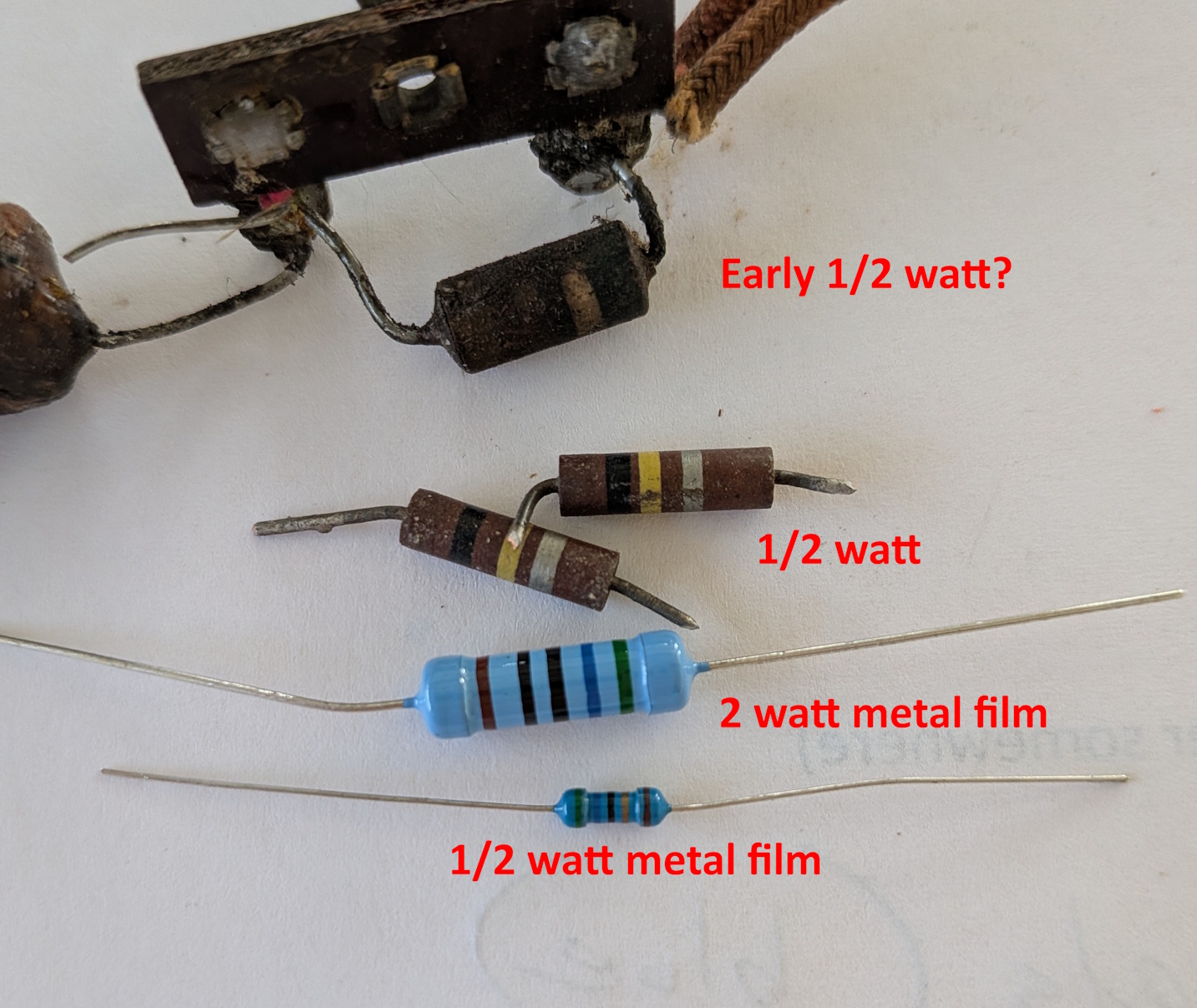
Modern 2 watt resistors closely match the old physical sizes and the leads are longer than the ¼ watt parts making it a lot easier for point-to-point wiring. Using a 2 watt in place of the smaller sizes does not cause a problem.
I don't think you can even buy 20% parts any more. Everything is 1% or 5%. Like the wattages, going better doesn't cause a problem.
I purchased several resistor assortments from Amazon. Modern electronics generally runs at low voltages and don't generally need
very high resistance values. The assortments are made with this in mind. I recall having a hard time finding something with
the 470,000 ohm value for instance. I wound up buying several assortments to get all I needed. And I did this before
realizing that I didn't need ¼ watt parts.
The parts come mounted in bits of tape for use in machine PC manufacturing equipment.
Pulling the parts from the tape to preserve every little bit of lead length gives you a pile of parts with gobs of glue on the ends of the wire that stick
to everything. Very annoying.
The color bands are A. a lot more complicated now and B. frequently done with ambiguous paint colors.
I suspect that some of the resistors I received were discards because they were painted the wrong colors. Or maybe the commercial PC board manufacturers never read the colors anyway so "Who cares?" In any case, I found myself measuring the resistances just to be sure.
Page: /Resistors/Resistors.shtml
Last modified: Sunday, 5 Jul 2026