Compare #1
Note the mispelling of 'SX-28'. I was using the tiny cellphone keyboard. Also, I did not ask which
version of their LLMs the various services are using.
For totally unknown reasons, both Claude and Gemini were treating some numbers
(but not all) as telephone numbers and providing HTML tags:
"Bands 1 through 5 (0.55 MHz to 21 MHz)"
I deleted those links and changed a lot of markdown things to HTML.
I also removed all the reference links provided. No need to link to those sites from
this website
Claude Prompt #1
Do you have information about the Hallicrafters sc-28 receiver?
I'm curious about it's input sensitivity
Claude Response #1
I couldn't find a Hallicrafters "SC-28" in any radio references — searches turned up
nothing under that exact designation. It's possible you mean the **SX-28 "Super
Skyrider"** (their well-known WWII-era communications receiver), since "SC-28"
isn't a documented Hallicrafters model or military designation I could locate.
If that's the one you're after, the SX-28's sensitivity spec
was 6-20 microvolts for 500 milliwatts output, varying by band. It covered 550 kHz to 43 MHz across six
bands and was known for its high fidelity audio together with high sensitivity, stability and
selectivity.
Could you double-check the model number? If you have a specific unit in hand, a nameplate or chassis
photo would help me track down the right spec sheet.
Claude Prompt #2
I mistyped sx-28
Claude Response #2
The SX-28 "Super Skyrider" had a sensitivity of **6‐20 microvolts for 500
milliwatts output**, varying by band and tuning range — the lower end (~6µV) on the higher-frequency
bands, and somewhat less sensitive down at the low end of coverage (550 kHz).
A few other relevant specs if useful:
- **Frequency coverage:** 550 kHz ‐ 43 MHz in 6 bands
- **IF selectivity:** 4.1 kHz @ -3dB (sharp), 12 kHz @ -3dB (broad)
- **Crystal filter:** 300 Hz wide @ -70dB
- **Audio
output:** 8 watts, push-pull
For context, that sensitivity was considered excellent for its
era (1940) — good enough that it was often paired with panoramic adaptors
for signal monitoring during WWII, since it could pull in weak signals well below what most
contemporary receivers could resolve.
ChatGPT Prompt #1
Do you have information about the Hallicrafters sc-28 receiver?
I'm curious about it's input sensitivity
ChatGPT Response #1
Yes. And I think there may be a small model-number issue worth clearing up first: **Hallicrafters made an S-28**, as well as the considerably more elaborate **SX-28 Super Skyrider**. I suspect you mean the **S-28**. There is good evidence that the S-28 was a commercial shortwave receiver of that era. ([Reddit][1])
As for **input sensitivity**, this is one of those cases where the published vintage specifications aren't
as straightforward as modern receiver specs. I don't want to give you a made-up number.
If you mean the **S-28**, I can dig into the original Hallicrafters documentation and determine:
* the specified sensitivity in **microvolts (µV)**
* whether that specification is for **AM/CW**, and under what bandwidth/output conditions
* the **antenna input impedance**
* how the S-28 compares with the **SX-28**
* and, importantly, what sensitivity you could realistically expect from a **properly
aligned/restored S-28 today**
If you're actually referring to the **SX-28**, tell me that, because its sensitivity is a
different story—and I can give you the actual numbers for it. ([Bama Manual Archive][2])
**If you have the radio in front of you, a photo of the front panel or the model/data
plate would also let me positively identify which one you have.**
ChatGPT Prompt #2
I mistyped sx-28
ChatGPT Response #2
Ah, yes — **SX-28**, the *Super Skyrider*. That makes much more sense.
I checked the original Hallicrafters documentation, and the published sensitivity specification is:
> **6 to 20 microvolts for 500 mW output**, varying across the receiver's
entire frequency range. ([Bitsavers][1])
The SX-28 covers approximately **550 kHz to 43 MHz** in six bands. ([QSL.net][2])
### But there's an important wrinkle
That **6‐20 µV figure is not the same thing as the sensitivity specification you'd see on
a modern communications receiver**. Hallicrafters specified the signal required
to produce **500 mW of audio output**, which is a fairly substantial output level.
So if you're asking something like:
> *"How weak a signal can my SX-28 actually hear?"*
the answer can be **considerably weaker than 6 µV**, depending on bandwidth, mode, noise level, and what you consider "usable reception."
The SX-28 is actually a fascinating receiver in this respect. It has **two RF amplifier stages** ahead of the mixer, a 455-kHz IF, a variable-bandwidth IF system, AVC, a noise limiter, and a BFO. ([Bitsavers][1])
If you're interested, I can go one step further and **work out the SX-28's sensitivity in dBm and compare it with modern receivers**, and explain what the **6‐20 µV specification really means in practical terms**. That gets particularly interesting when you're deciding what kind of antenna is appropriate for an SX-28.
ChatGPT Prompt #3
Work out the SX-28's sensitivity in dBm and compare it with modern receivers
ChatGPT Response #3
Absolutely. The interesting part is that the SX-28's **6‐20 µV sensitivity looks rather poor when converted directly to dBm**, but that comparison is somewhat misleading because Hallicrafters measured it very differently from modern receiver manufacturers.
The original SX-28 manual states that sensitivity for **500 mW audio output** was **6 to 20 µV over the receiver's frequency range**. ([Bitsavers][1])
### Converting the SX-28 specification
        Assuming the input voltage is referenced to a **50-ohm source**, the conversion is:

        | Input | Equivalent power |
        | ----: | ---------------: |
        |  6 µV |    **‐91.4 dBm** |
        | 10 µV |    **‐87.0 dBm** |
        | 20 µV |    **‐73.0 dBm** |
So, on a simple 50-ohm basis, the SX-28's published sensitivity corresponds to roughly **‐91 to ‐73 dBm**.
But here's the important part:
**You should not conclude that an SX-28 is 20‐40 dB less sensitive than a modern receiver.**
### Why the comparison isn't fair
The SX-28 specification says **"for 500 milliwatts output."** That's an enormous difference from the way modern receivers are normally specified.
For example, the modern Icom IC-7300 specifies:
* **SSB/CW:** 0.16 µV for 10 dB S/N in a 2.4-kHz bandwidth
* **AM:** 2.0 µV for 10 dB S/N in a 6-kHz bandwidth on HF
([ICOM Japan][2])
The Yaesu FT-891 specifies:
* **SSB/CW:** 0.158 µV for 10 dB S/N
* **AM:** 1.6 µV for 10 dB S/N on 1.8‐30 MHz
([Yaesu][3])
        Converting those to 50-ohm dBm:

        | Receiver                | Mode                 | Sensitivity |  Approx. dBm |
        | ----------------------- | -------------------- | ----------: | -----------: |
        | **Hallicrafters SX-28** | AM-era specification |        6 µV |  **‐91 dBm** |
        | **SX-28**               | AM-era specification |       20 µV |  **‐73 dBm** |
        | **Icom IC-7300**        | AM                   |      2.0 µV | **‐101 dBm** |
        | **Yaesu FT-891**        | AM                   |      1.6 µV | **‐103 dBm** |
        | **Icom IC-7300**        | SSB/CW               |     0.16 µV | **‐117 dBm** |
        | **Yaesu FT-891**        | SSB/CW               |    0.158 µV | **‐117 dBm** |
So the modern receivers appear to beat the SX-28 by **roughly 10‐44 dB**.
But that is **not an apples-to-apples comparison**.
### The really interesting question
For an SX-28, I would actually be much more interested in determining its **true minimum discernible signal (MDS)** under a controlled test.
The SX-28 has a very different philosophy from a modern SDR. It has **two RF amplifier stages**, a mixer, a 455-kHz IF system, variable IF bandwidth, AVC, noise limiter, and a BFO. The original design was aimed at making weak signals *usable*, rather than producing a spectacularly low sensitivity number under a modern standardized measurement.
And there's another very important consideration:
**On HF, the antenna and atmospheric noise often dominate the receiver's own noise.**
For example, if the antenna is delivering ‐100 dBm of atmospheric/galactic/man-made noise into the receiver, making the receiver itself capable of ‐120 dBm doesn't necessarily make the station any easier to hear.
That's one reason an old SX-28 can be surprisingly impressive in actual shortwave listening despite its apparently mediocre published sensitivity.
### I'd like to take this one step further
Since you originally asked about an **antenna for your SX-28**, there's a very useful calculation we can make next:
**How much signal does an SX-28 actually receive from a typical 50-, 100-, or 200-foot wire antenna?**
We can calculate the approximate voltage delivered by a wire antenna at different frequencies and compare it directly with the SX-28's sensitivity. That will tell us whether you actually *need* a large outdoor antenna, and what kind of antenna makes sense for the SX-28.
If that's what you're working toward, I can do that calculation for you.
ChatGPT Prompt #4
Please do
ChatGPT Response #4
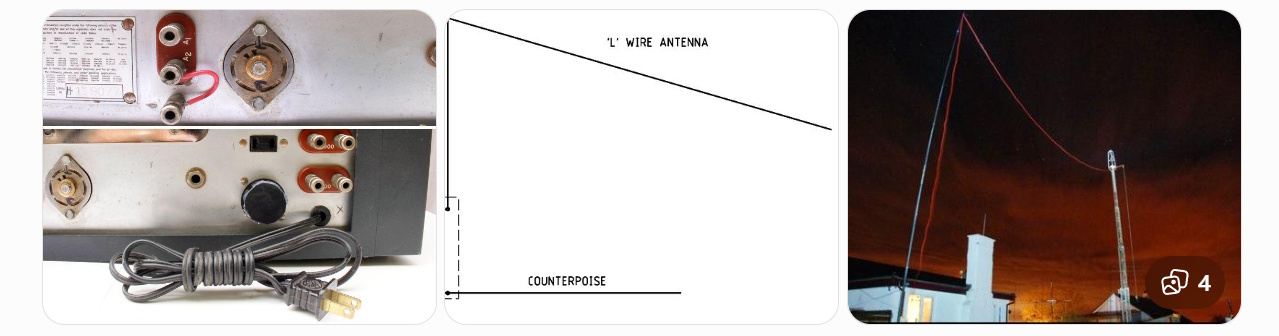
Yes — and now that I've checked the **original SX-28A instruction book**, there's a particularly useful piece of information for your antenna question: **Hallicrafters themselves recommended a 75‐100 ft inverted-L/Marconi antenna**, including the lead-in, for satisfactory reception across the tuning range. They also state that the receiver's approximate antenna input impedance is **400 ohms**. ([Bitsavers][1])
 ### Let's put some numbers on it
The SX-28 covers **550 kHz through 43 MHz** in six bands. Its published sensitivity is **6‐20 µV at the antenna terminals for 500 mW of audio output**. ([VMars Manuals][2])
Since the antenna input is about **400Ω**, we can make a better calculation
than the 50-ohm dBm conversion I gave you earlier.
### Let's put some numbers on it
The SX-28 covers **550 kHz through 43 MHz** in six bands. Its published sensitivity is **6‐20 µV at the antenna terminals for 500 mW of audio output**. ([VMars Manuals][2])
Since the antenna input is about **400Ω**, we can make a better calculation
than the 50-ohm dBm conversion I gave you earlier.
        For a 400-ohm input:

        * **6 µV** corresponds to about **‐90.5 dBm**
        * **10 µV** → about **‐86.1 dBm**
        * **20 µV** → about **‐80.1 dBm**
That's the power *at the receiver input* corresponding to the specified voltages.
But an outdoor wire antenna isn't a simple 400-ohm resistor, so we shouldn't pretend that a 100-ft
wire will deliver a fixed number of microvolts. Its received voltage varies
enormously with **frequency, orientation, height, ground, propagation, and the impedance
of the antenna system**.
### Here's the useful practical comparison
Consider a **100-ft (30.5 m) inverted-L**, which is almost exactly what Hallicrafters recommended.
        At different frequencies, its electrical length is approximately:

        | Frequency | Wavelength | 100-ft wire |
        | --------: | ---------: | ----------: |
        |     1 MHz |     984 ft |      0.10 λ |
        |     2 MHz |     492 ft |      0.20 λ |
        |   3.5 MHz |     281 ft |      0.36 λ |
        |     7 MHz |     141 ft |      0.71 λ |
        |    14 MHz |      70 ft |      1.43 λ |
        |    21 MHz |      47 ft |      2.14 λ |
        |    28 MHz |      35 ft |      2.86 λ |
This explains something important about the SX-28:
**A 100-ft wire isn't "too much antenna" for it.**
In fact, for the lower HF bands it's quite reasonable. Hallicrafters specifically recommended 75‐100 feet for general-purpose operation. ([Bitsavers][1])
### What about a 50-ft wire?
A 50-ft wire is only about half the length of the recommended antenna.
At 3.5 MHz, for example:
**50 ft ≈ 0.18 wavelength**
It will still work very well for strong shortwave stations, but compared with a properly installed 100-ft wire it generally gives you less signal and, depending on the installation, potentially a different noise pickup.
At 7 MHz, however:
**50 ft ≈ 0.35 wavelength**
and that's actually a very respectable receiving antenna.
So I wouldn't worry about making the antenna exactly 100 ft.
### And here's the really important point
For the SX-28, **receiver sensitivity probably isn't going to be your limiting factor with a decent outdoor antenna.**
Suppose your antenna delivers just **10 µV** to the receiver.
That's already right in the middle of the SX-28's published 6‐20 µV sensitivity range.
And 10 µV at 400Ω corresponds to approximately **−86 dBm**.
An outdoor antenna receiving a strong international shortwave station can deliver vastly more than that.
The situation becomes interesting with weak amateur, utility, or distant shortwave signals. Then the question isn't simply:
> "Is the SX-28 sensitive enough?"
It's:
> **"How much signal-to-noise ratio is the antenna system delivering to the SX-28?"**
And that's where antenna installation becomes *very* important.
### The SX-28's 400-ohm input is significant
Modern receivers are generally designed around **50Ω** systems. The SX-28 isn't.
Hallicrafters explicitly gives approximately **400Ω** as the receiver antenna input impedance
and discusses matching transmission lines to it. ([Bitsavers][1])
They recommend three basic arrangements:
**1. Inverted-L / Marconi**
75‐100 ft including lead-in, connected to A1, with the A2-G jumper in place.
**2. Doublet**
A center-fed half-wave antenna connected to A1 and A2.
**3. Half-wave antenna**
Hallicrafters even gives the formula:
**Length in feet = 463 / frequency in MHz**
For example, at 7 MHz:
**463 / 7 = 66.1 ft**
That's essentially a 40-meter half-wave dipole. ([Bitsavers][1])
---
## What I'd build for an SX-28
If your objective is **general shortwave listening rather than transmitting**, I'd personally lean toward the simplest option:
**80‐100 ft of wire, as high and as open as practical, configured as an inverted-L**, with a
good insulated feed point and a reasonably short lead-in to the SX-28.
That's remarkably close to what Hallicrafters themselves recommended nearly 85 years ago. ([Bitsavers][1])
And I would **not automatically put a modern 9:1 or 49:1 unun between it and the SX-28**.
Those devices are primarily intended to make a random wire convenient for modern 50-ohm equipment.
The SX-28 already has a roughly **400-ohm input**, so blindly transforming the antenna to 50Ω can actually
move you away from the arrangement the receiver was designed around.
### One thing I'd like to know about your installation
If you're asking this because you're actually going to put an antenna up for **your SX-28**, tell me approximately:
**how much room you have, how high you can get the wire, and whether you're mainly interested in AM broadcast, shortwave broadcast, amateur bands, or all of them.**
With those three pieces of information, I can design a **specific antenna for your SX-28**, including wire length, orientation, feed arrangement, ground connection, and whether I'd use the A1/A2/G terminals in your particular case.
Gemini Prompt #1
Do you have information about the Hallicrafters sc-28 receiver?
I'm curious about it's input sensitivity
Gemini Response #1
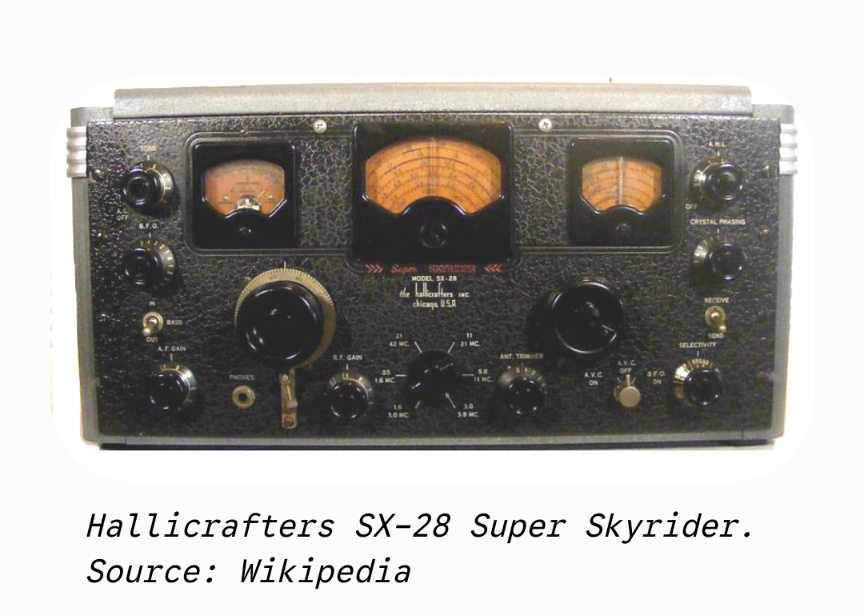
The Hallicrafters SX-28 was renowned for its impressive sensitivity when it
debuted in 1940. It achieves this high level of
performance through a sophisticated RF front-end design.
Across its tuning range of 0.55 MHz to 43 MHz, the
factory input sensitivity specifications are:
Bands 1 through 5 (0.55 MHz to 21 MHz): 2 microvolts (µV) or better.
Band 6 (21 MHz to 43 MHz): 4 microvolts (µV).
How It Achieves Its Sensitivity
The SX-28 utilizes a total of 15 tubes, and its
sensitivity relies heavily on its RF amplification stages.
For the top four bands (Bands 3 through 6), the receiver uses a double
preselection front-end. This means incoming signals pass through two separate 6SK7 RF amplifier stages before reaching the mixer.
For the lower two bands (Bands 1 and 2), the circuit bypasses the first RF amplifier, relying on single preselection.
Operational Considerations
According to the original Hallicrafters manual,
operators hunting for extremely weak or distant signals
can maximize the receiver's sensitivity by switching the AVC (Automatic
Volume Control) to the "OFF" position.
When the AVC is off,
the receiver operates at its maximum theoretical gain. However, the manual
warns that doing this requires the operator to manually ride the RF gain control;
otherwise, a sudden strong signal will overload the input circuit and cause
heavy distortion.
Page: /AI_notes/Compare_1/Compare_1.shtml
Last modified: Saturday, 15 Aug 2026